
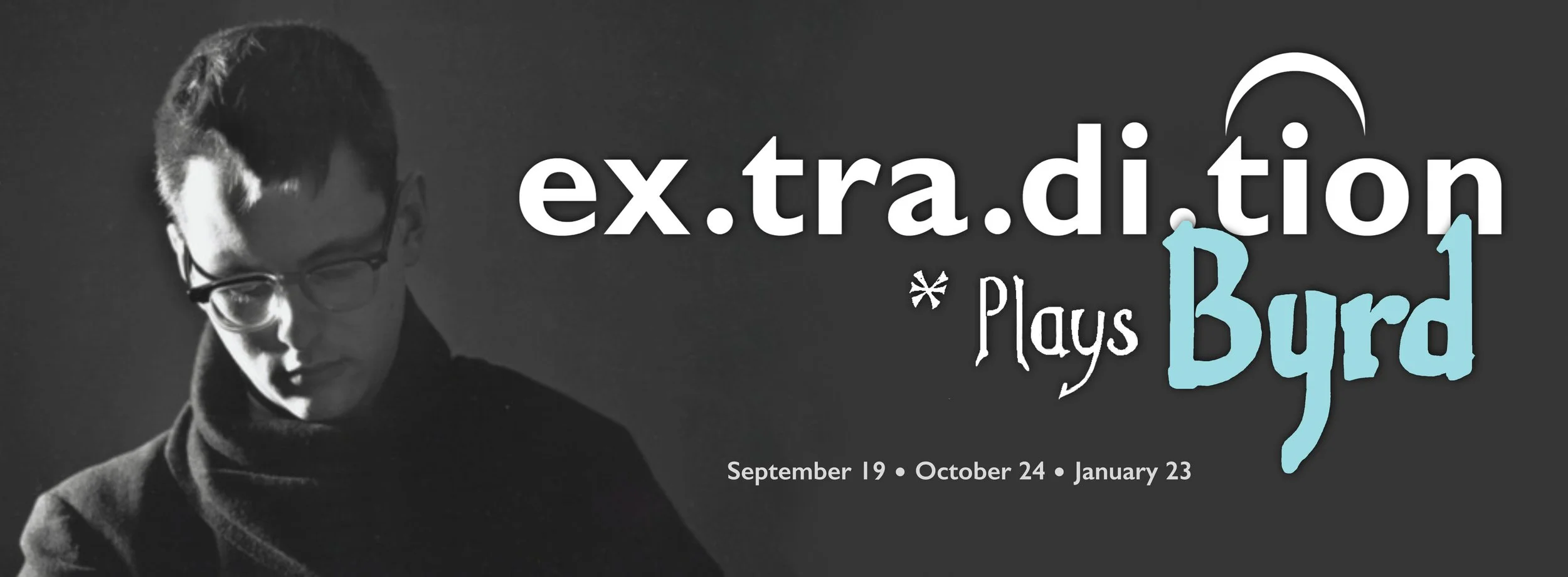
Joseph Byrd (1937–2025) was a member of the New York avant-garde during the remarkable 1960–63 period that also saw the emergence of our previous “Extradition Plays” honorees Philip Corner, Malcolm Goldstein, and James Tenney. Beginning September 19, 2026, Extradition will follow up our concerts dedicated to those three giants by presenting EXTRADITION PLAYS BYRD, with three concerts focused on the composer’s early-60s compositions.
SATURDAY, SEPTEMBER 19, 2026
Homage to Jackson Mac Low (1961): Ben Cohen-Chen, Annie Gilbert, Matt Hannafin, Gilly Ann Hanner, Collin Oldham, Anthony Stillabower, Stephanie Lavon Trotter (voices)
The Defense of the American Continent from the Viet-Cong Invasion (1966): James Boulton (Bass VI), Ben Cohen-Chen (tenor sax), Annie Gilbert (trombone), Gilly Ann Hanner (electric guitar), Collin Oldham (cello), Anthony Stillabower (piano), Logan Strosahl (alto sax), Shao Way Wu (bass)
Untitled I (undated): Ben Cohen-Chen (tenor sax), Annie Gilbert (trombone, voice), Matt Hannafin (percussion, melodica), Rebecca Novak (trumpet), Collin Oldham (cello), Anthony Stillabower (piano), Stephanie Lavon Trotter (voice), Shao Way Wu (bass)
Prelude to the Mystery Cheese Ball (1961): Ben Cohen-Chen, Annie Gilbert, Matt Hannafin, Gilly Ann Hanner, Rebecca Novak, Collin Oldham, Anthony Stillabower, Logan Strosahl, Stephanie Lavon Trotter, Shao Way Wu (balloons)
Two Pieces (for Richard Maxfield) (1960): audience
November Dragon (1961): Stephanie Lavon Trotter, Matt Hannafin (voices)
La Virgen de la Macarena (undated): Rebecca Novak (trumpet), Anthony Stillabower (conductor, playback), Tim Westcott (capture, playback), Ben Cohen-Chen (tenor sax), Annie Gilbert (trombone), Matt Hannafin (percussion), Gilly Ann Hanner (guitar), Collin Oldham (cello), Logan Strosahl (alto sax), Shao Way Wu (bass)
SATURDAY, OCTOBER 24, 2026
Densities I (1962): Michael Anderson (viola), Catherine Lee (oboe), Collin Oldham (cello), Andy Rayborn (clarinet), Anthony Stillabower (conductor), Logan Strosahl (flute)
Loops and Sequences (1961): Collin Oldham (cello), Jennifer Wright (piano)
For David Tudor (undated): Jennifer Wright (piano)
Four Sound-Poems (1962): Ben Cohen-Chen, Matt Hannafin, Juniana Lanning, Jennifer Wright (voices)
Fish (1961): Ben Cohen-Chen (tenor sax), Catherine Lee (oboe d’amore), Andy Rayborn (alto clarinet), Logan Strosahl (alto sax)
Animals (1961): Michael Anderson (viola), Loren Chasse (percussion), Matt Hannafin (percussion), Juniana Lanning (percussion), Collin Oldham (cello), Jennifer Wright (piano), Shao Way Wu (bass)
SATURDAY, JANUARY 23. 2027
Aria (undated): Stephanie Lavon Trotter (voice), Matt Hannafin (vibraphone)
Raga + Desert Music (undated): Catherine Lee (oboe d’amore), Juniana Lanning (electronics), Matt Hannafin (electronics)
Untitled II (undated): Jennifer Wright (piano), Juniana Lanning (piano), Loren Chasse (percussion), Matt Hannafin (percussion)
Dialogues (1961): Collin Oldham, Juniana Lanning, Stephanie Lavon Trotter (voices)
Tired Dragon (1960): Jennifer Wright (piano), Collin Oldham (cello)
Sonatina in A-flat (undated): Catherine Lee (oboe), Jennifer Wright (piano)
All concerts will be held at LEAVEN COMMUNITY, 5431 NE 20th Ave @ Killingsworth, Portland, Oregon, USA
Doors 7pm, music 7:30pm
Joseph Byrd: A Short Biography
Joseph Byrd (1937–2025) was a participant in San Francisco’s seminal musical avant-garde in the late 1950s, where he befriended young composers La Monte Young, Terry Riley, and Steve Reich. Moving to New York In 1960, he quickly became a fixture on the downtown scene, performing with Young, Riley, David Tudor, Charlotte Moorman, Philip Corner, Toshi Ichiyanagi, Jackson Mac Low, Terry Jennings, Yvonne Rainer, and many others. During this time he also studied with both Morton Feldman and John Cage, whom he assisted with the preparation of Atlas Eclipticalis for performance by Leonard Bernstein and the New York Philharmonic. He presented the first full program of his music on March 4–5, 1961, at Yoko Ono’s Chambers Street studio, part of the legendary loft series curated by Young. He also participated in performances by the Judson Dance Theater, was an early member of Fluxus, and presented a concert of his works at Carnegie Recital Hall. In 1963 he returned to California, where he studied ethnomusicology, co-founded the UCLA New Music Workshop, co-produced the first West Coast festival of experimental arts, wrote the liner notes for Cage's Variations IV LP, and played in a blues band with Linda Ronstadt. In 1967 he formed the psychedelic art-rock band The United States of America, with whom he released two albums on Columbia Records. In the 1970s he began teaching at California State University, Fullerton; became a recognized authority on 19th-century American popular music; and launched a long, distinguished career as a teacher, arranger, record producer, music director, and film music composer, working with the likes of Phil Ochs, Ry Cooder, Agnès Varda, Robert Altman, Tom Oberheim, and Don Buchla. In 1986 he moved to Humboldt County, CA, where he remained active in music and taught at the College of the Redwoods. He spent his final year as a resident of Medford, OR.
Joseph Byrd Resources
Loops and Sequences Podcast: In what turned out to be the last years of his life, Byrd was the subject of an interview podcast with journalist Paul Critz of Crescent City, CA, who recorded many hours of conversation detailing Byrd’s life and work. An essential resource. LISTEN.
American Contemporary Music Ensemble, Joseph Byrd: NYC 1960–63: The only album to date documenting Byrd’s early-1960s experimental works. A vital document. BUY
Joseph Byrd Interview: It’s Psychedelic Baby Magazine, 2013. READ
Joseph Byrd Interview: Clouds and Clocks, 2004. READ
The Singularity of Sound in a Plurality of Vision: The Early Works of Joseph Byrd: Liner notes by Eric Smigel for the album Joseph Byrd: NYC 1060–63 by the American Contemporary Music Ensemble (ACME). READ
New York Times Obituary: December 12, 2025. READ
Plus or Minus 1961– A Chronology 1959-1963: Gerard Forde’s remarkable chronology takes readers on a month-by-month journey through the early-1960s arts scene in which Byrd was immersed, and which produced many of its generation’s pivotal figures. READ